

I had been using ScoreApp for almost two years before I really took it seriously.
It was already useful.
We had used scorecards to generate work around LinkedIn profile optimization, positioning and building scorecards for clients.
Those projects were usually in the $1,000–$2,000 range.
Nothing wrong with that.
But in my head, ScoreApp was still mostly a clever lead magnet.
Then something changed in 2023.
Someone completed one of my LinkedIn assessments.
They saw gaps in the way their authority and personal brand were positioned.
The conversation wasn’t:
“Why would I need your help?”
It became:
“Okay. How do I fix this?”
That conversation eventually became a project worth roughly $7,000.
Another assessment-led conversation became a project worth roughly $7,500.
That was a significant jump.
And that was when I started looking at ScoreApp differently.
The scorecard had done something my PDFs and calendar links were not doing particularly well.
Before we spoke, the person had already:
thought about the problem
answered questions about their situation
seen where they were weak
received a personalized diagnosis
decided that the gap was worth fixing
The sales conversation started further down the road.
I discovered ScoreApp in 2021.
I started taking it seriously in 2023.
How I found it
My first encounter with ScoreApp happened almost accidentally.
Sometime around 2021, shortly after I went full-time into LinkedIn, I was watching a YouTube video by Ali Abdaal.
He shared a resource.
I clicked the link to download it.
Instead of the normal form asking for my name and email, I found myself answering questions.
One after another.
The experience felt unusually intuitive.
So I checked what it had been built with.
ScoreApp.
Around the same period, I was experimenting with Gumroad, starting my first Substack and trying to understand how online attention could turn into an actual business.
Naturally, I got curious.
I built my first free scorecard.
I had no idea at the time that it would eventually become one of the mechanisms I used to qualify inbound demand and win much larger projects.
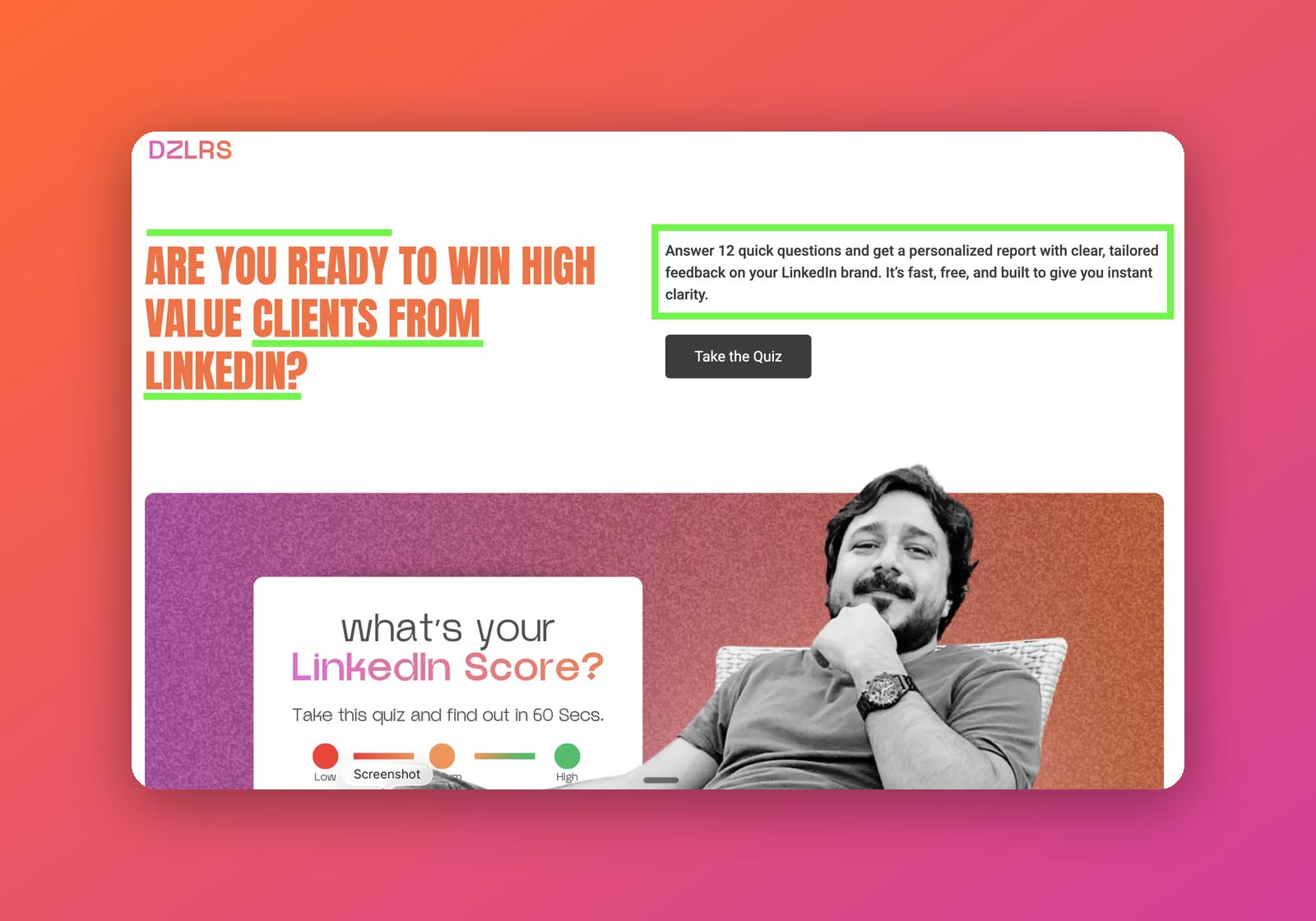
My current LinkedIn assessment starts with a readiness question: are you actually ready to win high-value clients from LinkedIn?
That question is important.
The scorecard isn’t called:
“Imran’s LinkedIn Questionnaire.”
Nobody cares about my questionnaire.
The prospect cares about something else:
Am I ready to win high-value clients from LinkedIn?
That is the first lesson.
Start with something your potential client genuinely wants to know about themselves.
Not what you want to ask them.
The problem with the PDF
I still love PDFs.
I sell them.
I give them away.
My previous issue was entirely about how I use Gumroad to turn a small digital product into a door to something larger.
But a PDF has a limitation.
Someone downloads my guide.
What have I learned about them?
Not very much.
I know they were interested enough to click.
Maybe LinkedIn is an urgent business problem.
Maybe they plan to work on it six months from now.
Maybe one post caught their attention.
Maybe they collect PDFs and will never open this one.
The download doesn’t tell me.
It doesn’t tell me:
their biggest problem
how severe it is
what they have already tried
whether they are ready to solve it
when they want to solve it
what kind of help they might want
All I really know is:
They downloaded something.
Before ScoreApp, I also had the opposite problem.
I would send people directly from LinkedIn to my calendar.
Someone would read something I wrote, click a link and book a call.
Great.
Except sometimes they weren’t a fit.
They needed something I didn’t sell.
Sometimes they weren’t remotely ready for my pricing.
Sometimes their problem had very little to do with the service I thought they were interested in.
There was no qualification between:
“I like what this person posts.”
and
“Let’s spend 30 minutes together.”
So I had two imperfect signals.
A download told me too little.
A calendar booking sometimes asked for too much.
The scorecard sat in between.
What a scorecard actually is
Forget ScoreApp for a moment.
A scorecard is simply a diagnosis.
You can call it:
an audit
an assessment
a quiz
a diagnostic
The person answers a short series of questions about their situation.
Those answers produce a score.
The score shows them where they currently stand.
It can also break the problem into different categories so they can see where they are strong and where they are weak.
Say you help businesses generate leads.
Your scorecard could measure:
offer
inbound
outbound
follow-up
Someone might score 70 overall.
But their offer score is 90 while their outbound system scores 30.
Now the problem is more useful.
They don’t simply know:
“I need more leads.”
They know where the system is weak.
The scoring can work the other way too.
If you’re measuring something undesirable, like stress or anxiety, a lower score may be better.
The number itself isn’t the important part.
The diagnosis is.
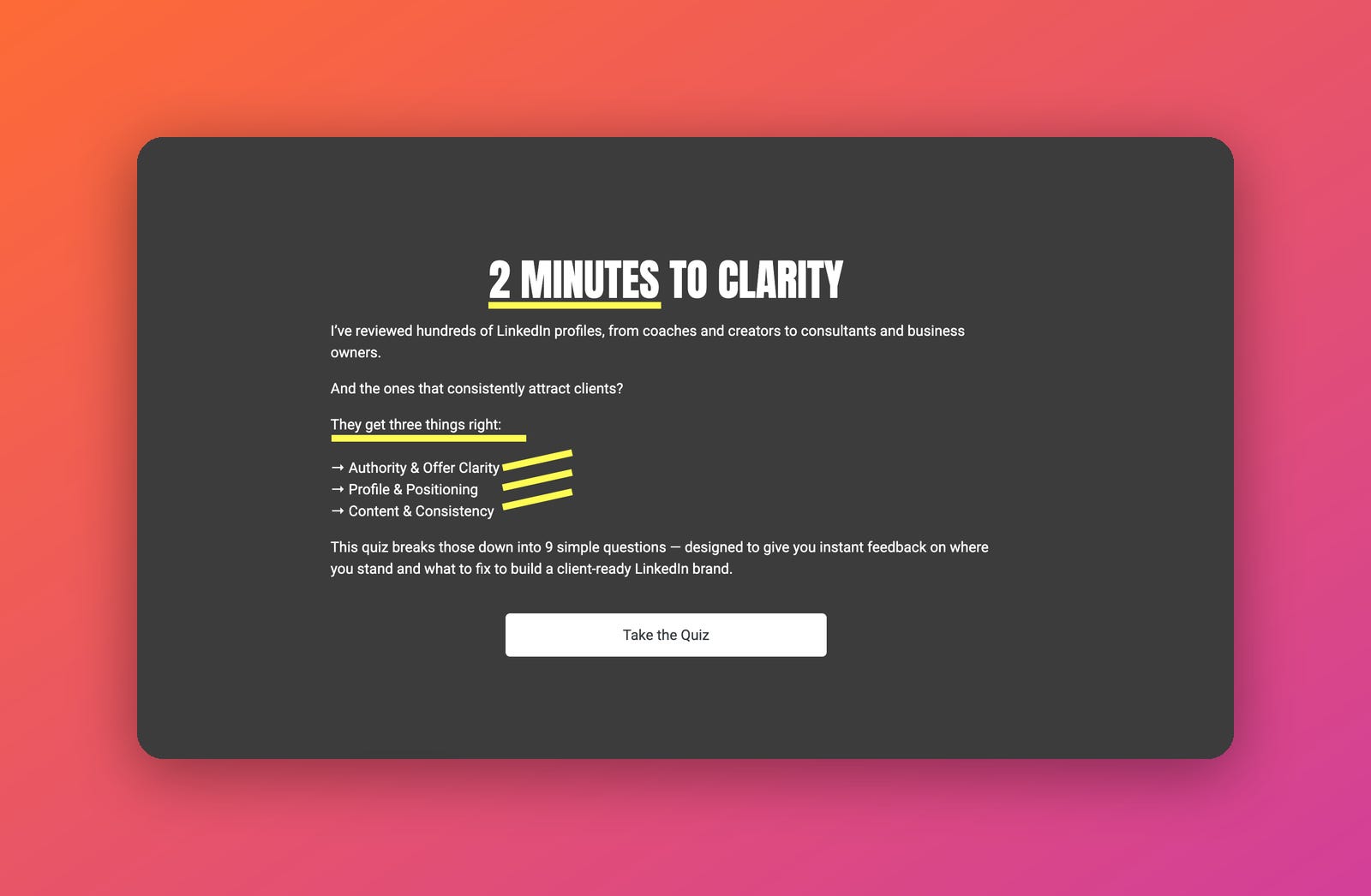
The original diagnostic was built around three areas: Authority & Offer Clarity, Profile & Positioning, and Content & Consistency. I later added three qualification questions.
This screenshot is from an earlier version of my assessment.
At that point, it had nine diagnostic questions.
It now has twelve.
But the idea hasn’t changed.
Give me two or three minutes.
I’ll give you clarity about where you stand.
That is a pretty good trade.
Why would anyone answer 12 questions?
Because people are interested in themselves.
A PDF says:
Here is what I know.
A scorecard says:
Here is where you stand.
That is a very different proposition.
If you download my LinkedIn guide, you still need to read it and determine which parts apply to you.
Maybe ten minutes.
Maybe twenty.
Maybe it sits unopened in your inbox.
With an assessment, the result changes based on your answers.
Someone scoring low needs different advice from someone scoring in the middle.
Someone who already has an excellent LinkedIn presence doesn’t need me explaining why they need a profile photo.
They may need help with the final ten percent.
That is real personalization.
Not:
Hi {First Name}.
But:
Based on what you just told me, this is where you’re strong and this is where the problem is.
Start with readiness or frustration
When people build their first scorecard, they often ask:
What should I make my quiz about?
I think that’s the wrong place to start.
There are two directions I particularly like.
Readiness
Your prospect wants something.
Maybe they want to:
win better clients
raise investment
hire a strong team
become an executive
grow a business
build authority
The assessment answers:
How ready are you?
My own assessment uses this angle:
Are you ready to win high-value clients from LinkedIn?
Frustration
The other option starts with a problem.
Maybe:
Why isn’t your LinkedIn generating leads?
Why does your pipeline keep drying up?
Why is your team still dependent on you?
Why does your scorecard get traffic but no leads?
In one case, people are moving toward something they want.
In the other, they are trying to understand something that hurts.
Both can work.
The important thing is that the scorecard starts with their question, not yours.
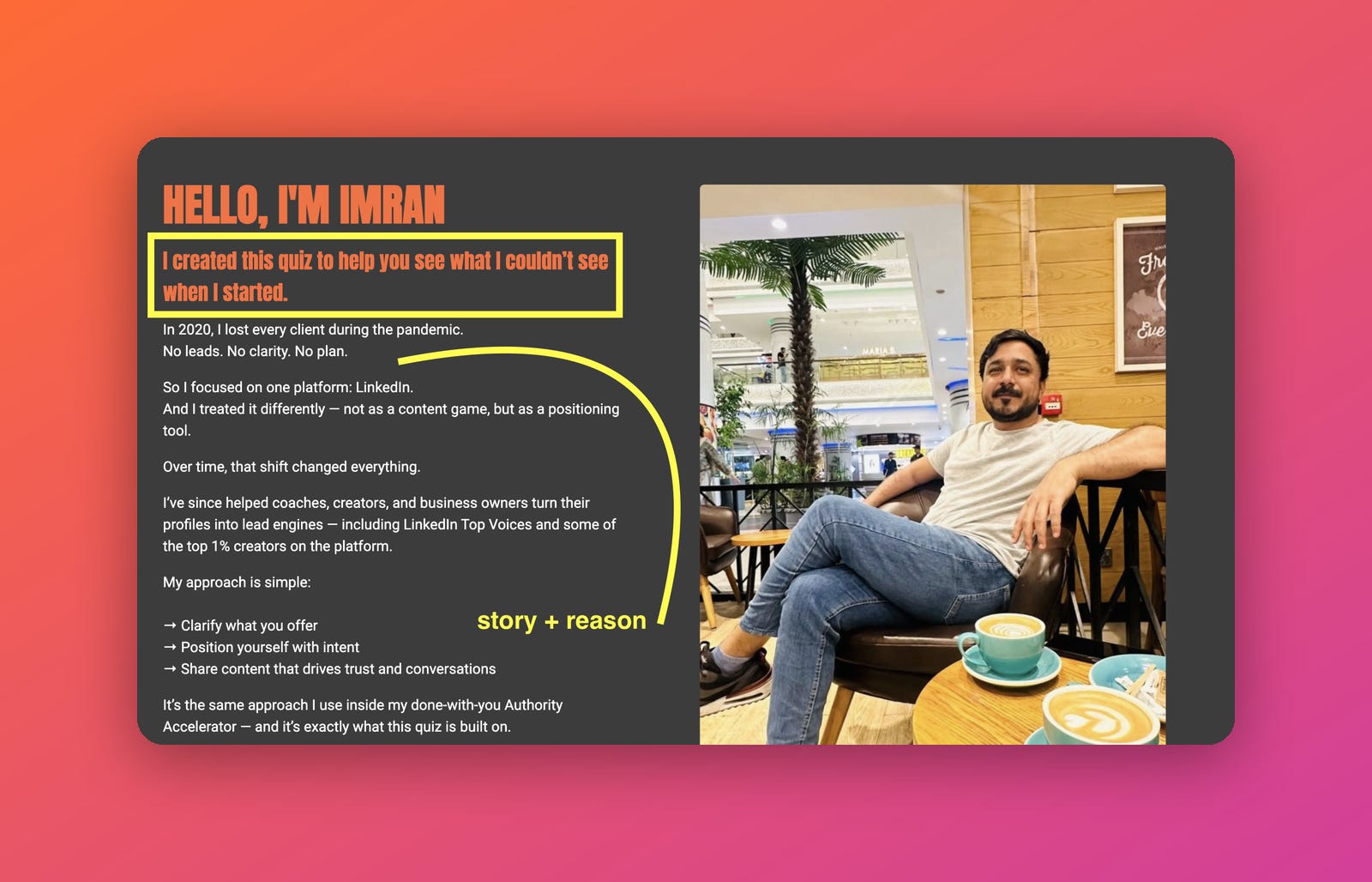
A scorecard landing page should also explain why you are qualified to diagnose the problem.
There is another piece people sometimes forget.
Why should anyone trust you to score them?
My landing page explains why I built the assessment in the first place.
In 2020, I lost every client during the pandemic.
I focused heavily on LinkedIn.
I learned what worked by solving my own problem first.
Later, I helped other coaches, consultants, creators and business owners do the same.
I would much rather explain that than write:
“Imran is a world-leading LinkedIn guru with unrivaled expertise.”
Your story can do some of the credibility work.
The three parts you actually need
A ScoreApp funnel can become sophisticated.
Mine certainly has.
But a beginner does not need all of that.
Start with three things.
1. The landing page
The landing page has one job:
Get the right person to start.
It should answer:
What will I discover?
Why should I care?
How long will this take?
What will I get afterward?
Why should I trust you?
Keep distractions low.
You don’t need seventeen links sending people around your website.
Make the value of taking the assessment obvious.
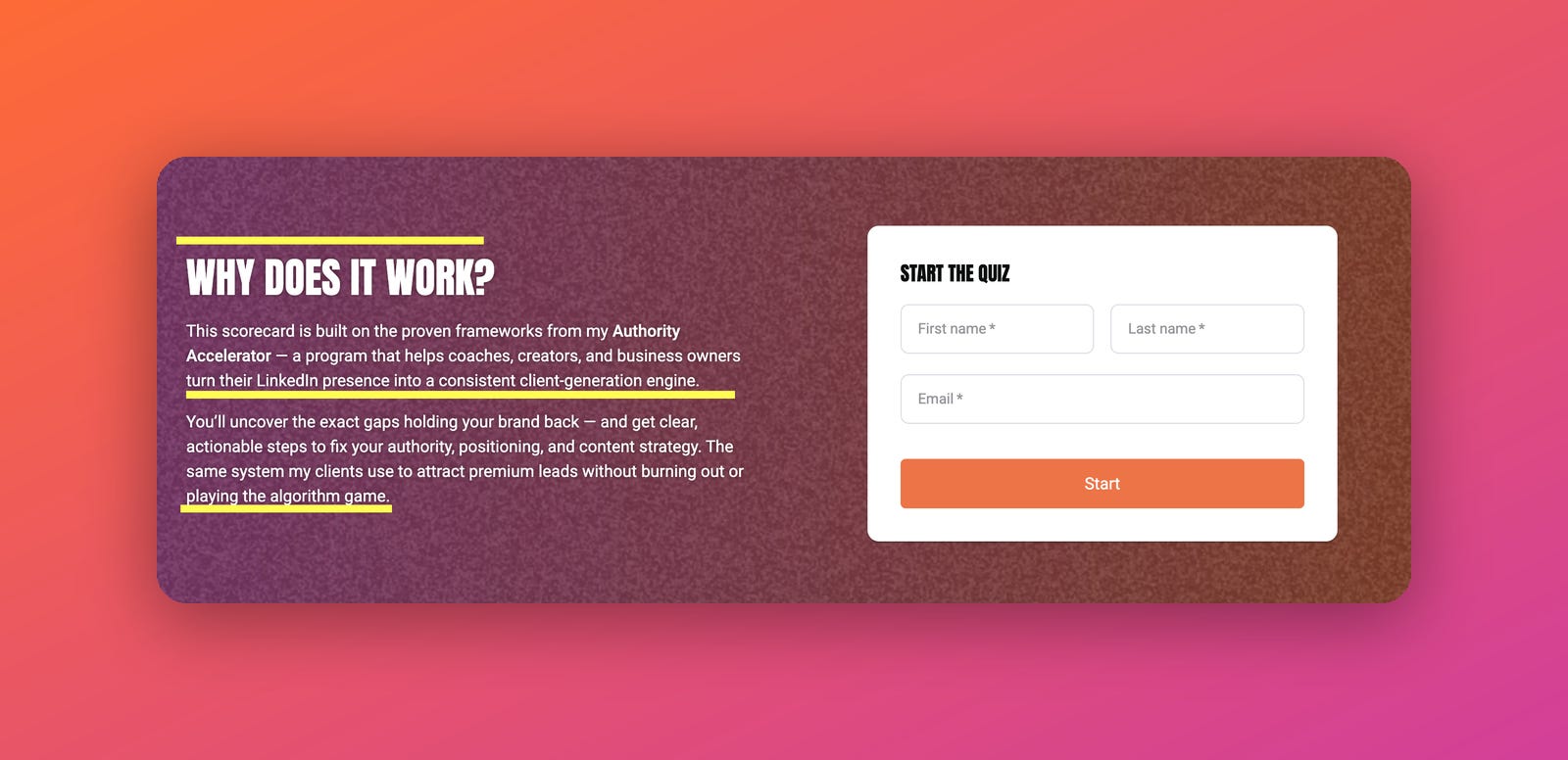
The free assessment is a smaller expression of the same framework behind the larger paid service.
This part is crucial.
Your scorecard should connect directly to the larger problem your business solves.
If you’re a fractional CFO, don’t build:
The Fractional CFO Quiz.
Build something your potential client cares about:
Is your business financially ready to scale?
If you’re a leadership coach:
Are you ready for your first executive role?
If you’re a branding consultant:
Is your positioning strong enough to win premium clients?
The assessment diagnoses a slice of the bigger problem.
Your paid service helps solve more of it.
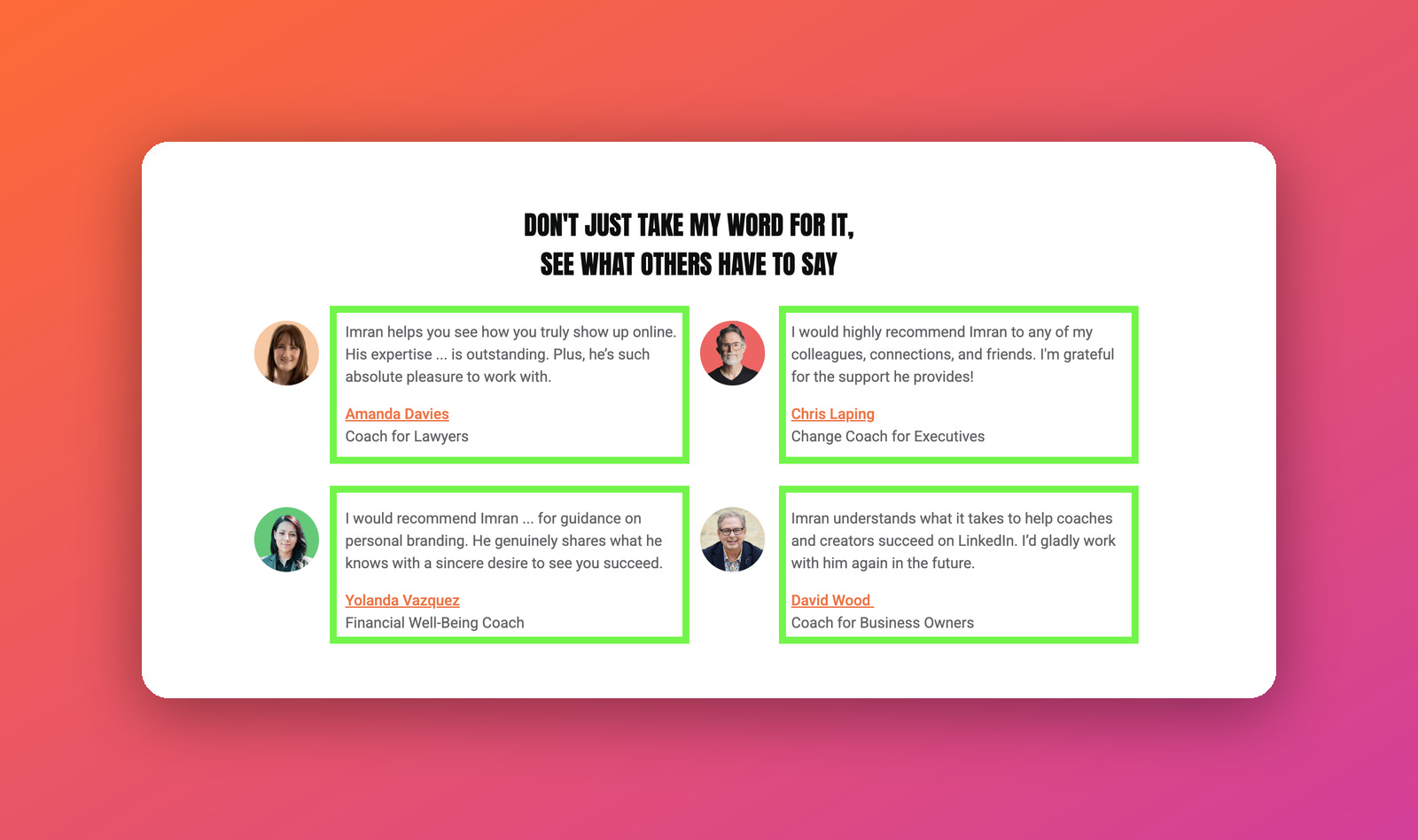
Before asking someone to trust your diagnosis, give them a reason to trust the person doing the diagnosing.
A scorecard landing page is still a landing page.
Proof matters.
Testimonials matter.
Credibility matters.
If someone is about to accept your assessment of their business, career or marketing, they should have some reason to believe you understand the subject.
2. The questions
This is where people love making life unnecessarily complicated.
My rule is simple:
One question should do one job.
Don’t write an academic exam.
Don’t put three questions inside one.
Don’t fill it with jargon.
Don’t choose complicated formats simply because the software lets you.
Every question should collect one useful piece of information.
And you should know what that answer means.
I generally like around 10–15 questions across three or four categories.
Enough to learn something meaningful.
Short enough that people actually finish.
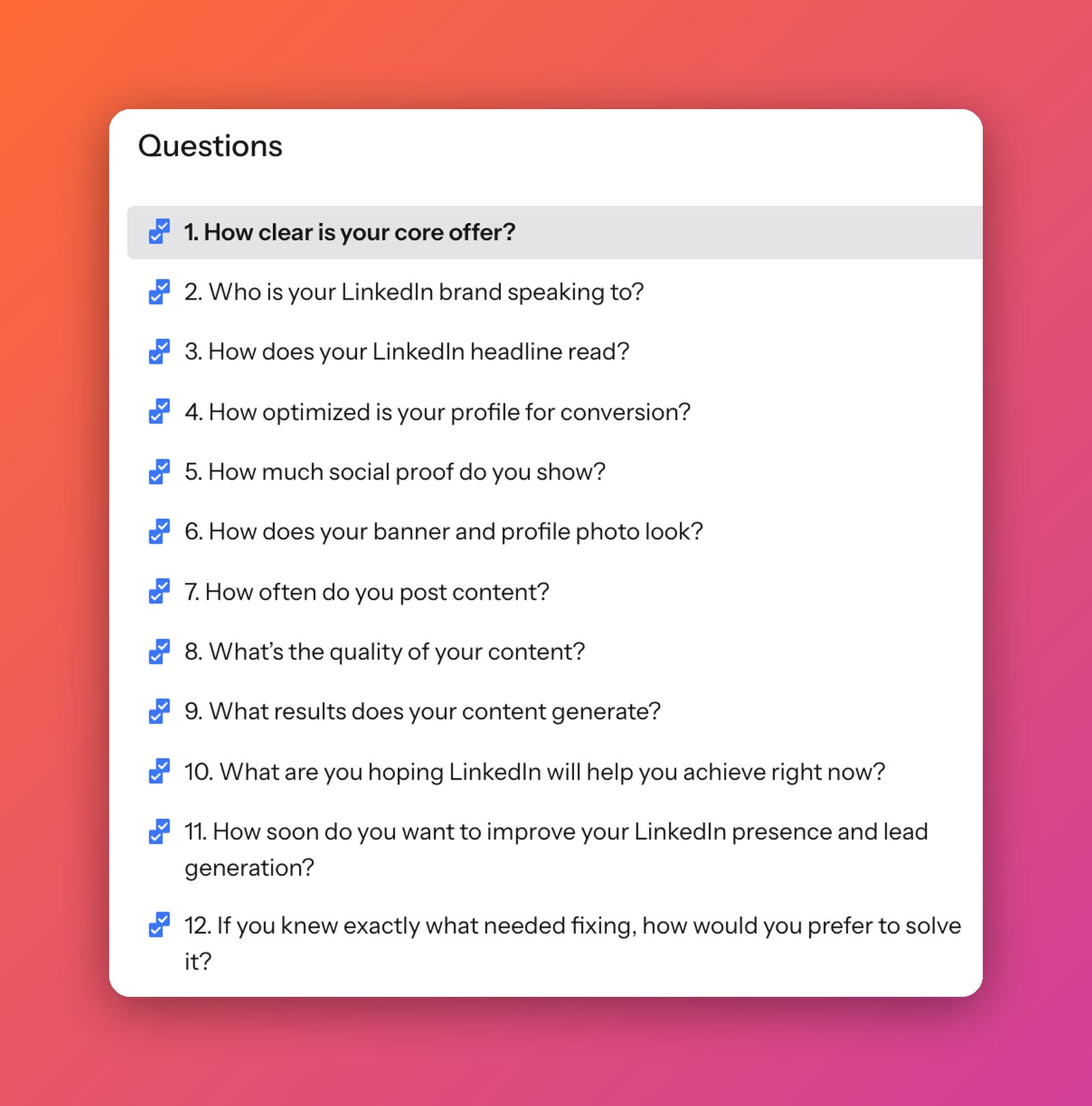
The first nine questions diagnose the LinkedIn problem. The final three help qualify the person behind the score.
My current LinkedIn assessment has nine diagnostic questions.
They cover things such as:
clarity of the offer
audience
headline
profile conversion
social proof
visual positioning
content consistency
content quality
business results from content
Then I added three different questions.
10. What are you hoping LinkedIn will help you achieve right now?
This tells me the desired outcome.
Are they trying to build reputation?
Generate leads?
Win higher-value clients?
Grow their network?
Or are they merely exploring?
11. How soon do you want to improve your LinkedIn presence and lead generation?
This tells me timing.
Immediately is very different from:
“Maybe sometime in the next six months.”
12. If you knew exactly what needed fixing, how would you prefer to solve it?
This tells me what kind of support they are open to.
Do they want to:
figure it out themselves
use templates or guides
get coaching
build it with an expert
have someone do most of it for them
I prefer this to bluntly asking:
What is your budget?
There is a place for budget questions.
But if I can understand someone’s desired outcome, urgency and preferred level of help, I already know considerably more about the commercial opportunity.
One important distinction:
These three questions do not affect their LinkedIn score.
The first nine diagnose the problem.
The last three help me understand the person behind it.
That is where a quiz begins turning into a lead system.
3. The result page
If you’re going to collect personalized answers, don’t ruin everything by showing everybody the same generic result.
My result pages change based on the score.
Someone scoring low needs a different conversation from someone scoring high.
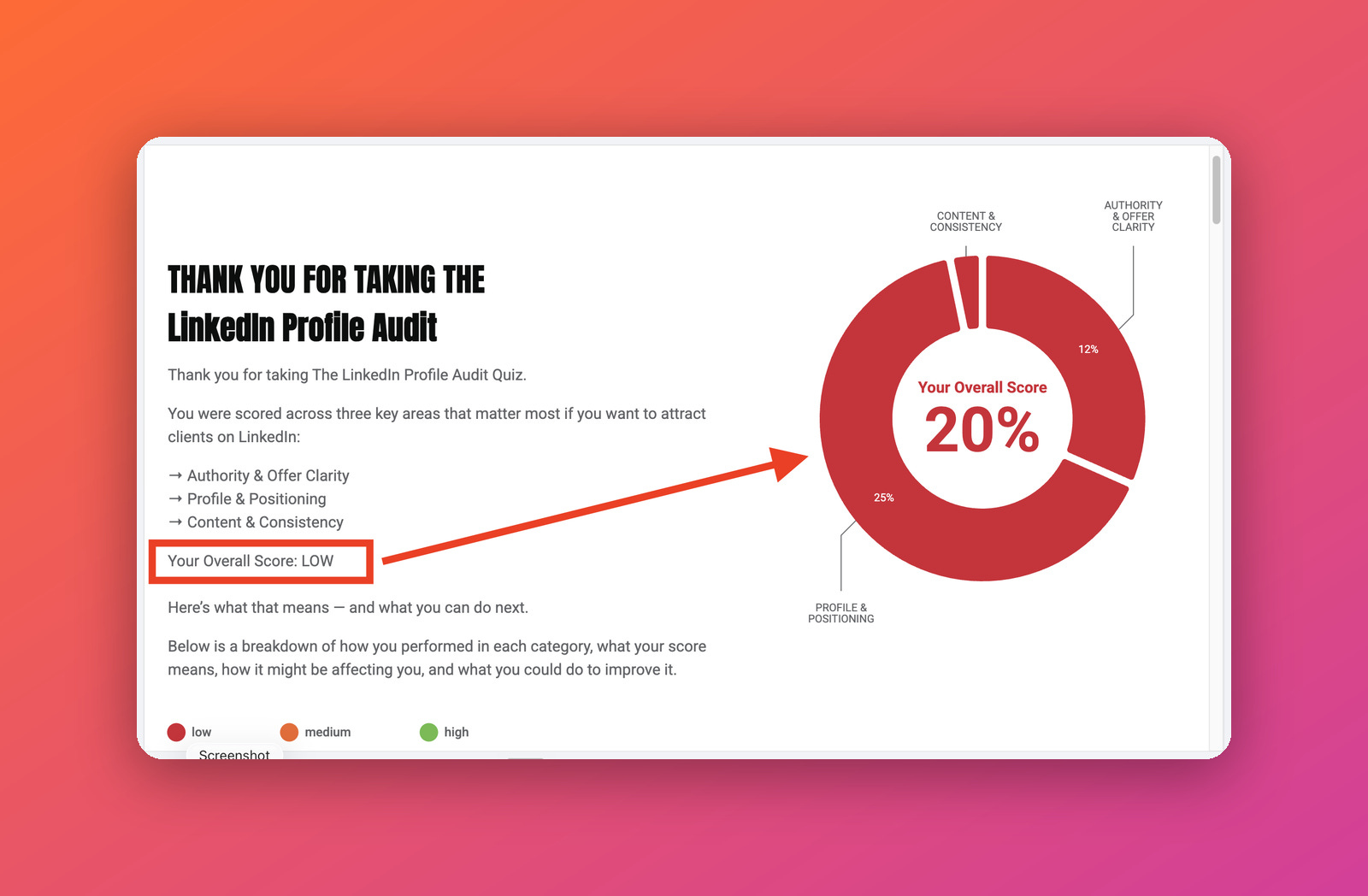
Low score: the prospect needs fundamentals, clarity and a clear starting point.
A low score makes the gap visible.
Something isn’t working.
Maybe the offer is unclear.
Maybe the profile isn’t positioned correctly.
Maybe the content does nothing commercially.
The problem is no longer:
“LinkedIn just isn’t working for me.”
Now there is something more specific to examine.
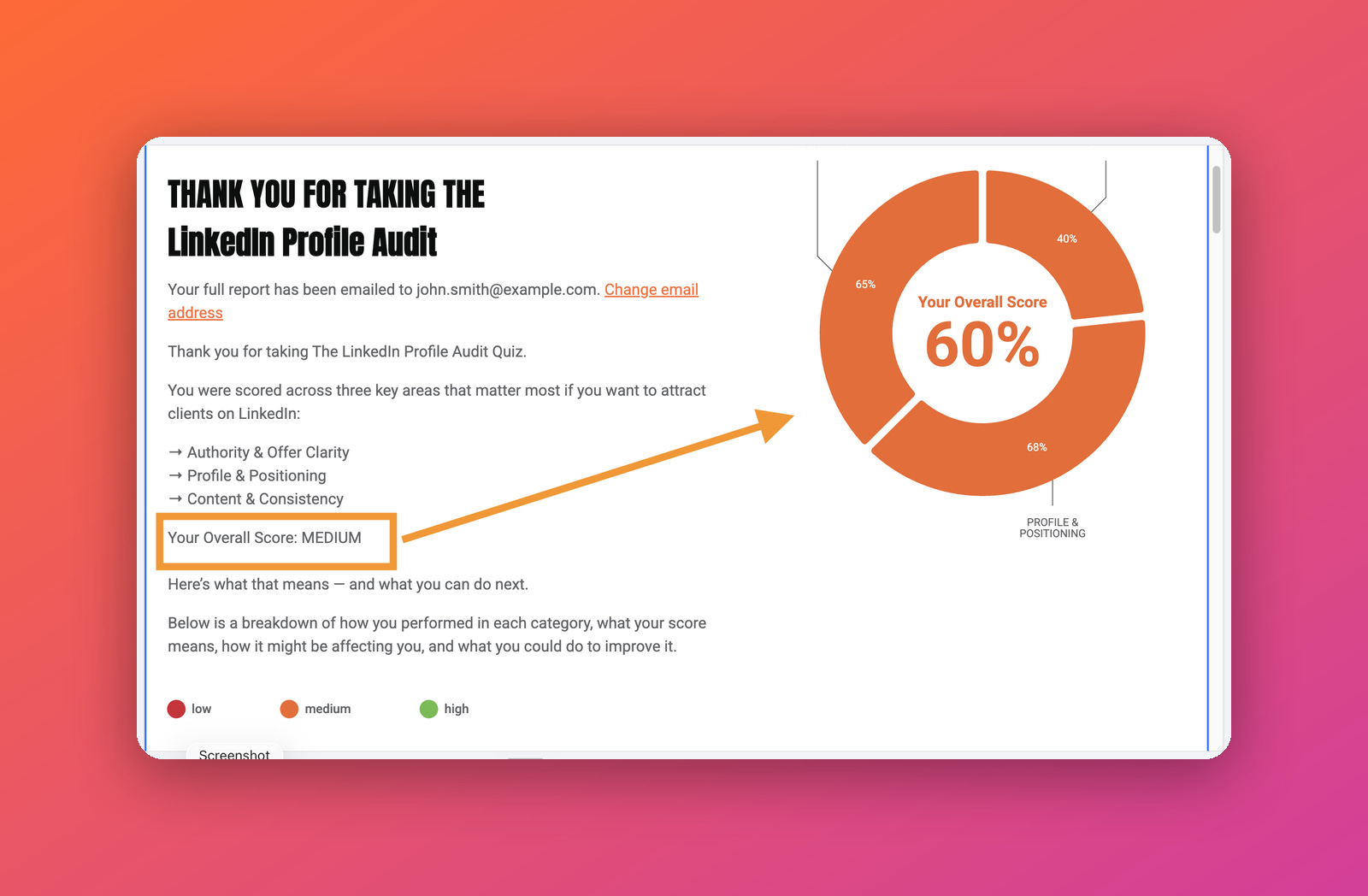
Medium score: enough is working to create momentum, but important gaps are still stopping consistent results.
The middle is particularly interesting.
A lot of potential clients aren’t beginners.
They have experience.
They post.
They have a decent profile.
Maybe they already have some authority.
But the pieces aren’t working together well enough to consistently produce business.
They don’t need to start again.
They need to see what’s missing.
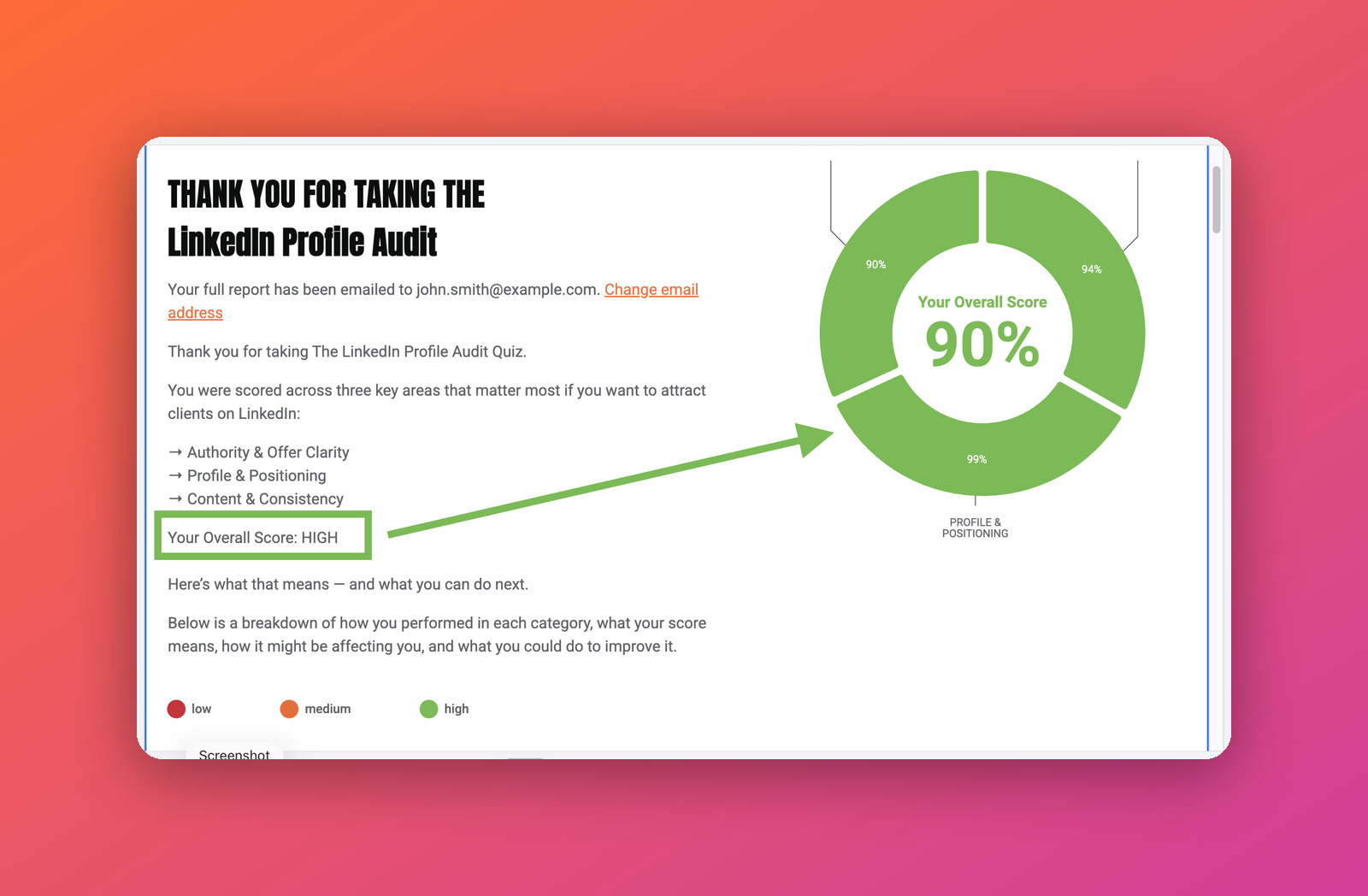
High score: this person needs refinement and opportunity, not beginner advice.
A high scorer should not receive the same recommendations.
If someone’s profile, positioning and content are already strong, the opportunity might lie in conversion, distribution, outbound or a more sophisticated lead system.
That is the point.
Different situation.
Different guidance.
The prospect learns about themselves.
I learn about the prospect.
This is probably the biggest advantage ScoreApp gave me over a normal lead magnet.
The person gets their diagnosis.
I get context.
Depending on the questions, I can understand:
where they are weak
what they want
how urgent the problem is
what they have tried
how they want to solve it
whether their problem actually matches what I sell
That does not mean every person who finishes the assessment becomes a sales lead.
They shouldn’t.
A respondent becomes commercially interesting when I see two things:
Problem + intent.
Someone can have a terrible LinkedIn presence and absolutely no intention of fixing it.
They are not necessarily a lead.
Someone else might have a moderate score but tell me:
I need to fix this immediately and I want someone to help me build it.
Very different conversation.
Building a scorecard does not generate leads
This is important.
I could give you the perfect ScoreApp template today.
You could build it beautifully.
You could write brilliant questions.
And you could still get zero leads.
Because ScoreApp does not distribute your scorecard for you.
Content and conversations do the heavy lifting.
Once your assessment exists, put it where your potential clients already encounter you.
That could be:
LinkedIn posts
your Featured section
LinkedIn comments
DMs
your website
email
WhatsApp
existing customers
colleagues
relevant communities
events
QR codes
offline conversations
You can even say:
“I built this short assessment for people dealing with X. It takes two minutes. Do you know anyone who would find it useful?”
Your scorecard itself can also produce months of content.
One question becomes a post.
One category becomes a post.
One common weak score becomes a post.
One misconception becomes a post.
One insight from respondents becomes a post.
One high-score behavior becomes a post.
One result becomes a case study.
You can easily find 10–30 pieces of content inside one good assessment.
You will not get three leads, ten leads or even one lead merely because the scorecard exists.
You have to distribute it.
And I wasn’t particularly good at that
This makes my own numbers more interesting.
For much of the period shown in my dashboard, I wasn’t actively promoting the assessment every week.
There was also a roughly 90-day period when my city experienced a complete internet shutdown.
For an online business, that is about as useful as it sounds.
I couldn’t consistently publish.
I couldn’t reliably run my normal online workflow.
And I certainly wasn’t running an optimized scorecard promotion machine.
Keep that context in mind when you see the numbers later.
Don’t buy traffic too early
Yes, you can eventually test Google Ads.
Meta Ads.
Paid distribution.
But I wouldn’t start there.
First, prove the thing works with actual people.
Get five completions.
Then ten.
Talk to them.
Ask:
Did your result feel accurate?
Was anything confusing?
Did you learn anything?
Was there a question that made you want to quit?
Did the recommendations make sense?
Improve the assessment.
I would rather interview five to ten people who actually completed it than spend $500 sending strangers into a broken funnel.
Scale after you know the diagnosis is useful.
What happens when someone finishes?
Today, my setup is considerably more advanced.
I have experimented with automation, Netlify, GitHub and AI-assisted lead analysis.
Ignore all of that for now.
You don’t need it to get your first lead.
My original workflow was embarrassingly simple.
Someone completed the assessment.
I looked at their answers.
I checked who they were.
If relevant, I looked at their LinkedIn profile.
Then I contacted them.
Something like:
Thanks for taking the assessment. I noticed X was one of the weaker areas in your score. Are you actively trying to improve that right now?
That’s enough.
Start the conversation.
If they said yes and the problem matched something I could help with, I could offer a call.
The call was an option.
Not a trap at the end of a quiz.
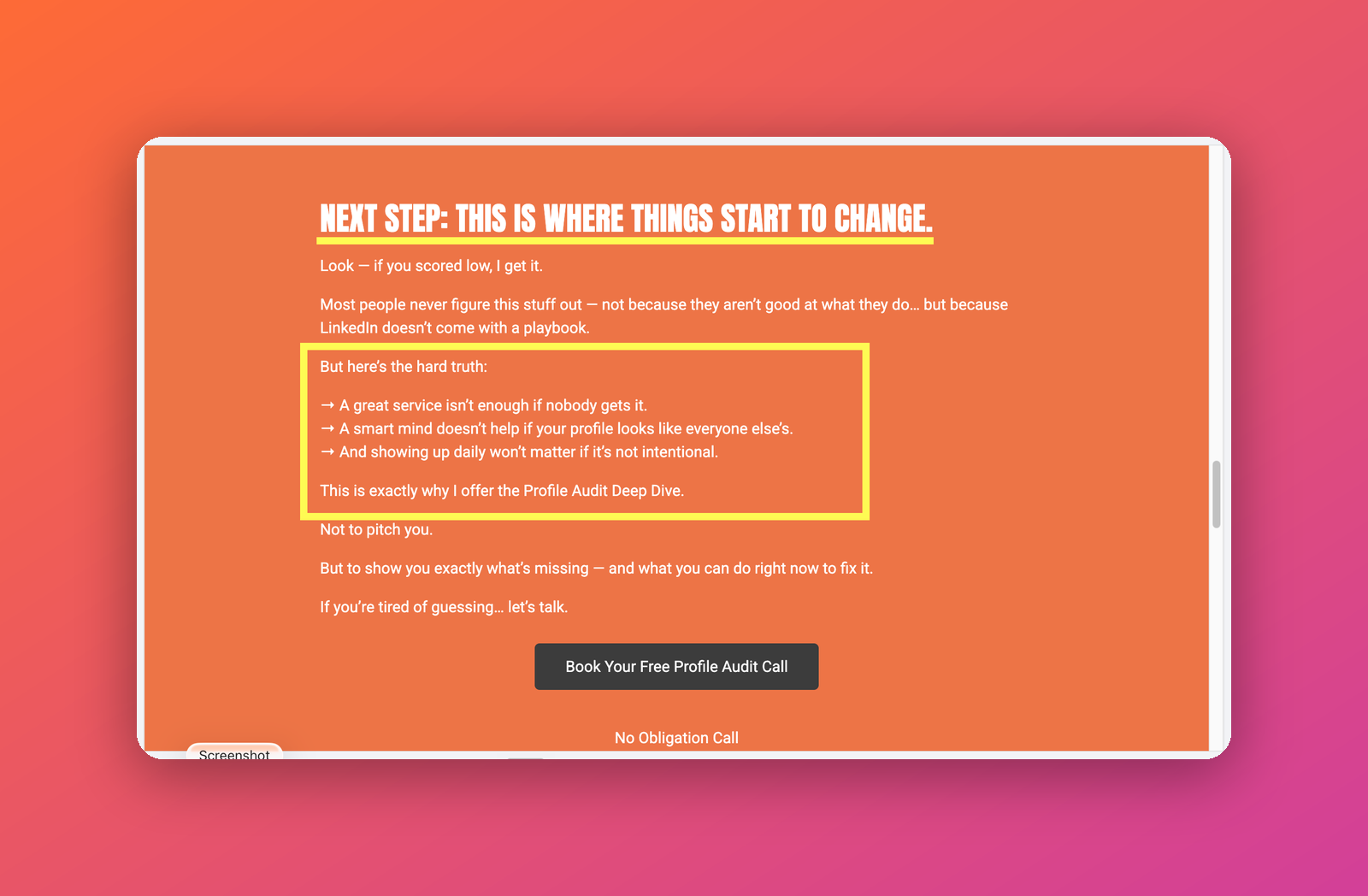
A useful result page should not end with a number. It should explain what the number means and offer a logical next step.
A score without guidance is interesting.
A score with guidance is useful.
A score with guidance and an optional conversation can become commercially valuable.
The result page should help the person answer:
What does my score mean?
What should I fix first?
What can I do myself?
What is the fastest next step if I want help?
What this has looked like in practice
Here is the current dashboard from one of my ScoreApps.
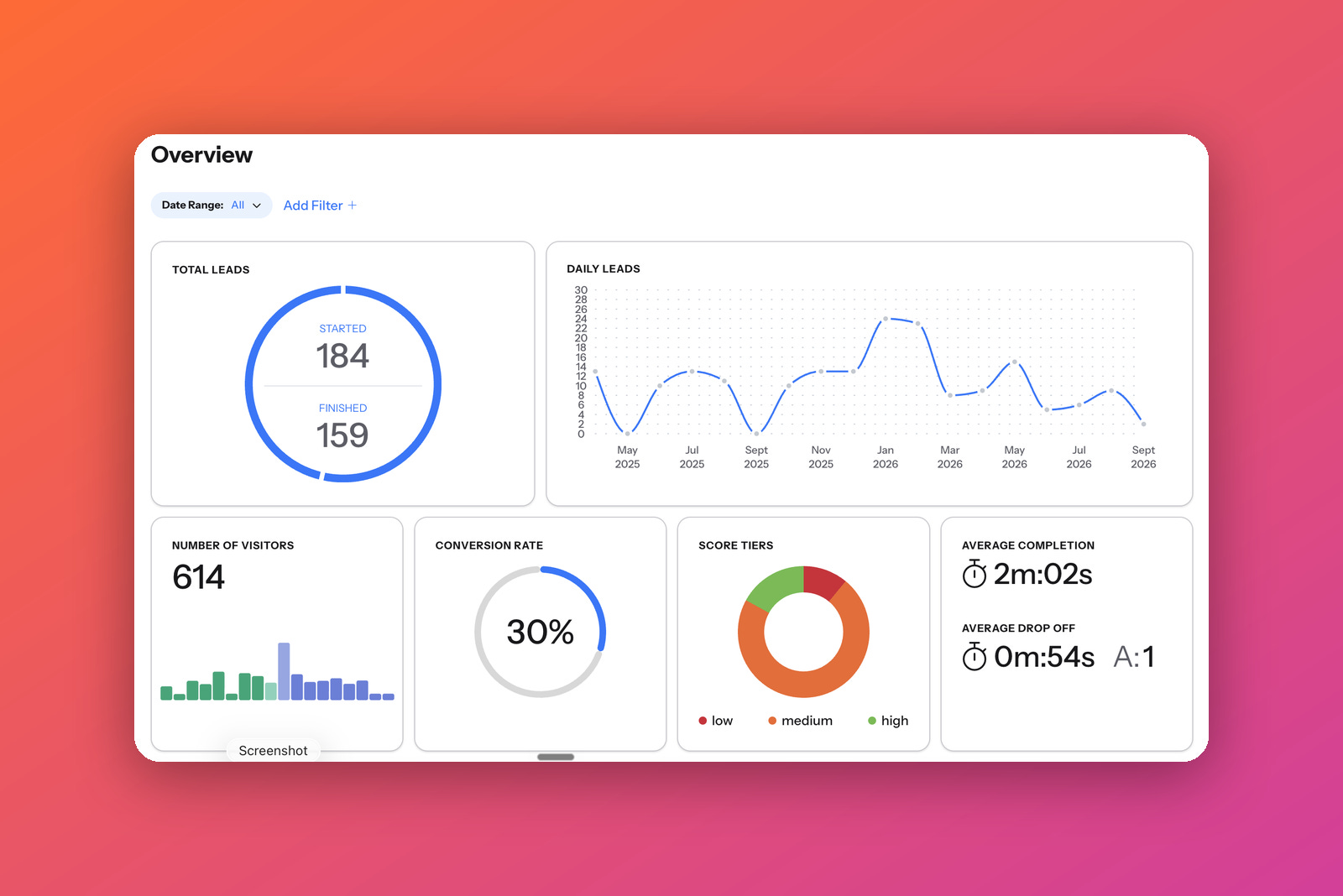
614 visitors, 184 starts and 159 completed assessments. Average completion time: 2:02.
The dashboard shows:
614 visitors.
184 people started.
159 people completed the assessment.
ScoreApp shows a 30% conversion rate.
The average completion time is just 2 minutes and 2 seconds.
And of the people who started, roughly 86% finished.
Across roughly the period represented here, those 159 completions work out to about nine completed assessments per month.
Again, context matters.
I was not promoting the assessment consistently throughout this period.
And for roughly three months, a complete internet shutdown in my city made normal online work extremely difficult.
So I don’t look at nine completions a month and think:
That’s the ceiling.
I look at it and think:
That happened without consistent distribution.
It also gives some context to the idea of generating 3–10 qualified leads a month.
I would never tell you:
Build a ScoreApp and ten qualified clients will appear every month.
That’s nonsense.
Historically, this particular assessment has averaged roughly nine completions a month.
Until recently, I also wasn’t asking the three explicit qualification questions I added above.
So I cannot honestly call every historical completion a qualified lead.
Nor should I.
The goal now isn’t to make all nine people prospects.
The goal is to find the three, five or perhaps ten people whose:
problem
timing
intent
desired outcome
preferred level of support
make a genuine conversation worth having.
That’s a far more useful metric than simply growing an email list.
And sometimes those conversations become much bigger
This is what made me start taking ScoreApp seriously.
Before 2023, we had already generated work from assessments.
Often $1,000–$2,000 projects around things like:
profile optimization
positioning
scorecard builds
Then came the roughly $7,000 engagement.
Another became roughly $7,500.
I don’t want you to misunderstand what happened.
The scorecard did not close a $7,000 deal.
It wasn’t a magic sales page.
It helped create a better conversation.
The person could see a problem.
I had useful context before speaking to them.
We both entered the conversation understanding more than we would have known from:
“Hey, I saw your LinkedIn post. Can we talk?”
That was the value.
What I would change if I started again
I would think less about building a quiz.
And more about building the journey.
The assessment itself is only one piece.
You need:
the right promise
good questions
useful results
qualification
distribution
follow-up
a logical next step
I would also make my questions simpler from day one.
One question.
One job.
One piece of information.
I would test the scorecard with real people before trying to scale it.
I would write the follow-up before launch.
And I would spend more time speaking to people who complete it.
A dashboard can tell you somebody scored 53.
A conversation can tell you whether that 53 actually mattered.
Build your first scorecard in seven days
You do not need to spend three months on this.
Here is how I would do it now.
Day 1: Find the problem
Start with the larger problem your business already solves.
Then decide:
Are you measuring readiness?
Or frustration?
Write the promise before opening ScoreApp.
If the promise isn’t compelling outside the software, the software will not save it.
Day 2: Build version one
Create three or four categories.
Write roughly 10–15 straightforward questions.
Add two or three qualification questions.
Build:
landing page
questions
basic scoring
low result
medium result
high result
Don’t obsess over design yet.
Day 3: Try to break it
Take your own assessment.
First, answer like someone doing terribly.
Then take it again as an average prospect.
Then as your ideal high-performing client.
Do the results make sense?
Are they different?
Do the recommendations fit?
Write the first follow-up message.
Day 4: Ask other people to test it
Share it with:
colleagues
clients
people who understand the problem
the official ScoreApp community
Don’t ask:
Do you like my quiz?
Ask:
Was anything confusing?
Did the result feel accurate?
Did you learn anything?
Where did you almost quit?
Day 5: Get another audit
Have someone who understands scorecards, funnels or lead generation look at the whole journey.
Landing page.
Questions.
Scoring.
Results.
CTA.
Follow-up.
You can also send it to me.
More on that in a moment.
Day 6: Fix it
Incorporate the feedback.
Shorten questions.
Remove unnecessary fields.
Clarify the promise.
Improve weak result copy.
Fix confusing scoring.
Then test it again.
Do not chase perfection.
Remove obvious friction.
Day 7: Put it in front of people
Publish it.
Then distribute it.
LinkedIn.
Email.
Website.
DMs.
WhatsApp.
Relevant communities.
Existing network.
Offline conversations.
Do not spend another three weeks polishing the button color.
The scorecard nobody sees will produce exactly zero leads.
The beginner’s scorecard checklist
Before you launch, can you answer these?
What expensive problem does this assessment connect to?
Am I measuring readiness or frustration?
Why would someone care about knowing their score?
Can they complete it in a few minutes?
Does each question collect one useful piece of information?
Do I have three or four useful categories?
Do my qualification questions reveal intent without turning the quiz into a sales form?
Does the result actually change depending on the answers?
Does the result tell people what they can do next?
What will I do when the first person completes it?
Where will I promote it this week?
Have at least five real people tested it?
If the answer to several of those is no, I wouldn’t buy traffic yet.
Fix those first.
Where this eventually took me
I discovered ScoreApp because I wanted to download someone else’s resource.
I used it casually.
Then I started selling smaller services through it.
Then assessments began leading to larger work.
Then we began building scorecards for clients.
And eventually, that became a service of its own.
Today, DZLRS is an official ScoreApp Agency Partner.
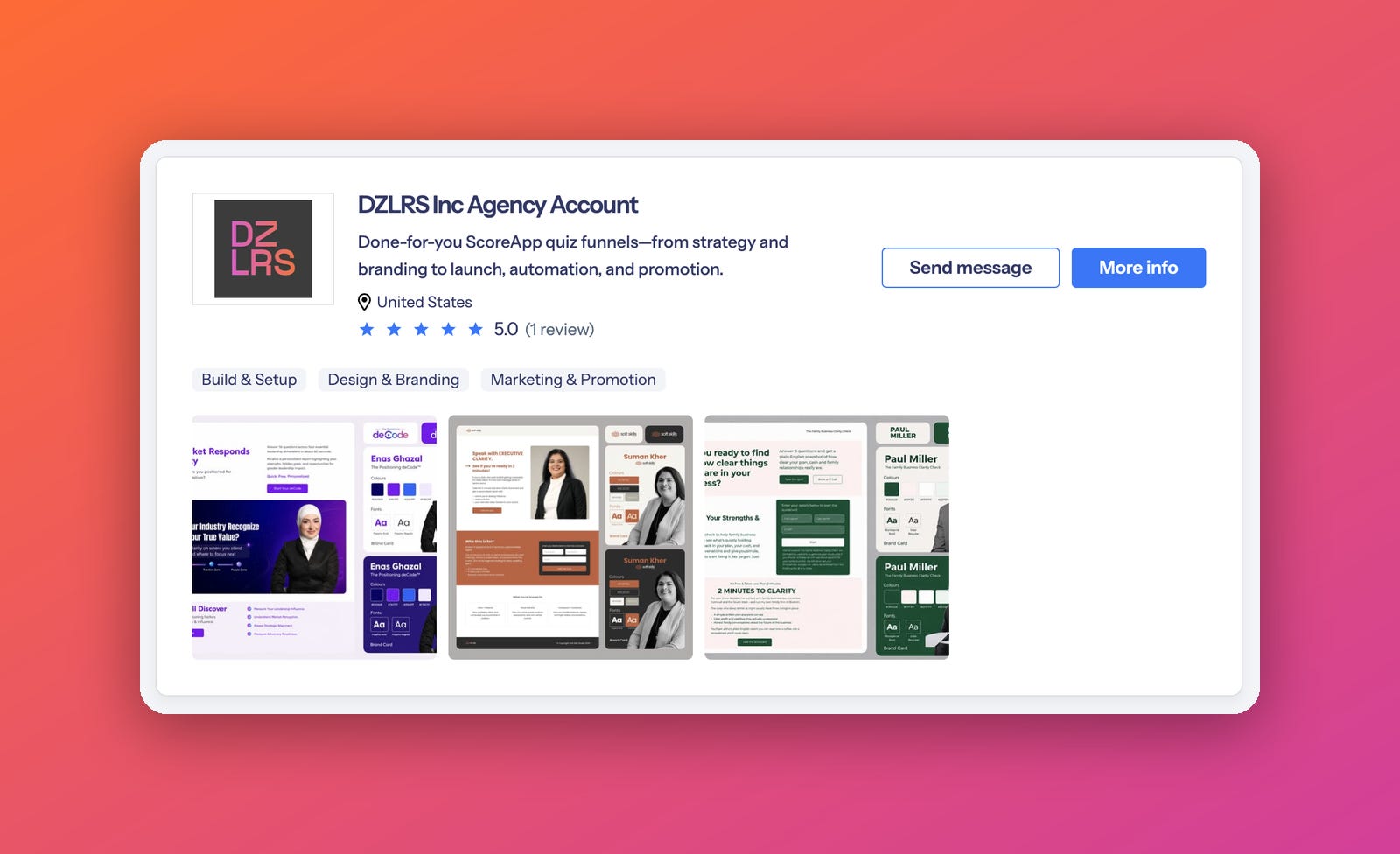
DZLRS is now listed in ScoreApp’s official Partner Directory for Build & Setup, Design & Branding, and Marketing & Promotion.
Today, we help businesses build done-for-you ScoreApp funnels covering things such as:
strategy
positioning
scorecard architecture
questions and scoring
branding and design
results
launch
automation
promotion
You can see our official ScoreApp Agency Partner profile here:
https://www.scoreapp.com/partner-directory/dzlrsinc/
I mention this for two reasons.
First, it gives me considerably more experience with ScoreApp than merely having an affiliate link.
Second, you should know that I now have a commercial relationship with the company.
But the order matters.
I didn’t become a ScoreApp partner and then start telling people how useful ScoreApp was.
I:
discovered it → used it → sold services through it → won larger projects through it → built scorecards for clients → then became an Agency Partner.
Want to build yours?
If you sell expertise, I would seriously consider testing an assessment before creating your next generic lead magnet.
Choose one problem your ideal client wants to diagnose.
Build a short assessment around it.
Give them a personalized result.
Then put it in front of people.
If you want to use ScoreApp, you can use my partner link and get:
50% off your first month.
https://share.scoreapp.com/20b6fcce
And I’m adding something of my own.
If you use my link, send me the scorecard you build. I’ll personally review it and send you personalized feedback for free.
Not a generic checklist.
I’ll look at your actual scorecard.
The promise.
Questions.
Qualification.
Result journey.
And where I think it could improve.
Disclosure
I’m an independent ScoreApp Agency Partner, so I may earn a commission from eligible customers who sign up through my partner link.
I discovered and started using ScoreApp years before becoming a partner.
I recommend it because it became part of how I generate and qualify leads and how we build lead-generation systems for clients.
If I find something that does this job better, I’ll tell you that too.
One final thought
A PDF tells me you downloaded something.
A calendar tells me you want to talk.
A scorecard tells me why.
And when you sell expertise, that context can be considerably more valuable than another email address sitting in your database.
If you’re serious about creating demand for your services, also check out how I use Gumroad to do exactly that.
How I use Gumroad to generate demand

In September 2021, I started selling a LinkedIn guide on Gumroad.